


Get Your Heart Health Questions Answered
The more you know about cholesterol and heart health, the better prepared you may be to make the right choices for your heart. Whether you've been recently diagnosed with high cholesterol or have been managing cholesterol for a while, you probably have some questions. This section contains answers to common questions about high cholesterol, heart health, and LIPITOR.
Questions About LIPITOR
Click on a question for the answer.
- Q: What is LIPITOR?
-
A: LIPITOR is a prescription medicine that is used along with a low-fat diet to manage cholesterol. LIPITOR is a type of medicine called a statin. LIPITOR is used to manage cholesterol levels. Along with diet and exercise, LIPITOR is clinically proven to lower bad cholesterol 39%-60% (average effect depending on dose).
LIPITOR, along with diet, is also used to reduce the risk of heart attack, stroke, certain kinds of heart surgeries, and chest pain if you have heart disease or several common risk factors for heart disease, including family history of early heart disease, high blood pressure, age, low HDL ("good") cholesterol, or smoking.
To find out more about LIPITOR, click here.
- Q: What are the possible side effects of LIPITOR?
-
A: LIPITOR can cause serious side effects. These side effects have happened only to a small number of people. Your doctor can monitor you for them. These side effects usually go away if your dose is lowered or LIPITOR is stopped. These serious side effects include:
- Muscle problems. LIPITOR can cause serious muscle problems that can lead to kidney problems, including kidney failure. You have a higher chance for muscle problems if you are taking certain other medicines with LIPITOR
- Liver problems. LIPITOR can cause liver problems. Your doctor may do blood tests to check your liver before you start taking LIPITOR, and while you take it
Call your doctor right away if:
- You have muscle problems like weakness, tenderness, or pain that happen without a good reason, especially if you also have a fever or feel more tired than usual
- You have allergic reactions including swelling of the face, lips, tongue, and/or throat that may cause difficulty in breathing or swallowing, which may require treatment right away
- You experience nausea and vomiting
- You pass brown or dark-colored urine
- You feel more tired than usual
- Your skin and whites of your eyes get yellow
- You feel stomach pain
- You have an allergic skin reaction
In clinical studies, patients reported the following common side effects while taking LIPITOR: diarrhea, upset stomach, muscle and joint pain, and alterations in some laboratory blood tests.
The following additional side effects have been reported with LIPITOR: tiredness and tendon problems.
Talk to your doctor or pharmacist if you have any side effects that bother you or that will not go away.
These are not all the side effects of LIPITOR. Ask your doctor or pharmacist for a complete list.
Or, to find out more about the side effects of LIPITOR, click here.
- Q: Is LIPITOR right for me?
-
A: LIPITOR is a prescription medicine. Only your doctor can properly determine if you need a prescription medicine along with diet and exercise to lower your high cholesterol.
Make an appointment with your doctor and ask if LIPITOR is right for you. Want to make sure you ask your doctor the right questions? Click here for a helpful doctor discussion guide.
- Q: Who should not take LIPITOR?
-
A: Do not take LIPITOR if you:
- Are pregnant or think you may be pregnant, or are planning to become pregnant. LIPITOR may harm your unborn baby. If you get pregnant, stop taking LIPITOR and call your doctor right away
- Are breast feeding. LIPITOR can pass into your breast milk and may harm your baby
- Have liver problems
- Are allergic to LIPITOR or any of its ingredients. The active ingredient is atorvastatin
- Q: When is the best time to take LIPITOR?
-
A: LIPITOR is taken once a day. It can be taken with or without food, day or night. It's helpful to remember to try and take LIPITOR at about the same time every day.
To find out more about how to get the most from treatment with LIPITOR, click here.
- Q: Do I need to take LIPITOR with food?
-
A: LIPITOR can be taken with or without food.
To find out more about how to get the most from treatment with LIPITOR, click here.
- Q: What if my daily schedule interferes with taking my medicine?
-
A: Try to take your medicine at the same time every day. Try connecting your medication with something you do every day, such as brushing your teeth or eating breakfast. This may help you remember.
Keep a daily calendar and add taking your medicine to your daily to-do list. Check it off once you have taken it. Or set an alarm clock to go off at the time you need to take your medication.
You can also use a pill box with the days of the week on it. Some pill boxes even come with built-in alarms!
You should also use a calendar to remind yourself to get refills before you run out of medicine.
To find out more about how to get the most from treatment with LIPITOR, click here.
- Q: Can LIPITOR be prescribed to children?
-
A: LIPITOR is for adults and children over 10 whose cholesterol does not come down enough with exercise and a low-fat diet alone.
LIPITOR is not approved for use in patients younger than 10 years of age.
- Q: What should I do if I am taking other prescription medications in addition to LIPITOR?
-
A: Tell your doctor about all the medicines you take, including prescription and nonprescription medicines, vitamins, and even herbal supplements. LIPITOR and certain other medicines can interact, causing serious side effects.
- Q: What if I can't always afford to refill my medication?
-
A: If you are uninsured or need help paying for Pfizer medicines, Pfizer has programs that can help. Call 1-866-706-2400 or click here www.PfizerHelpfulAnswers.com.
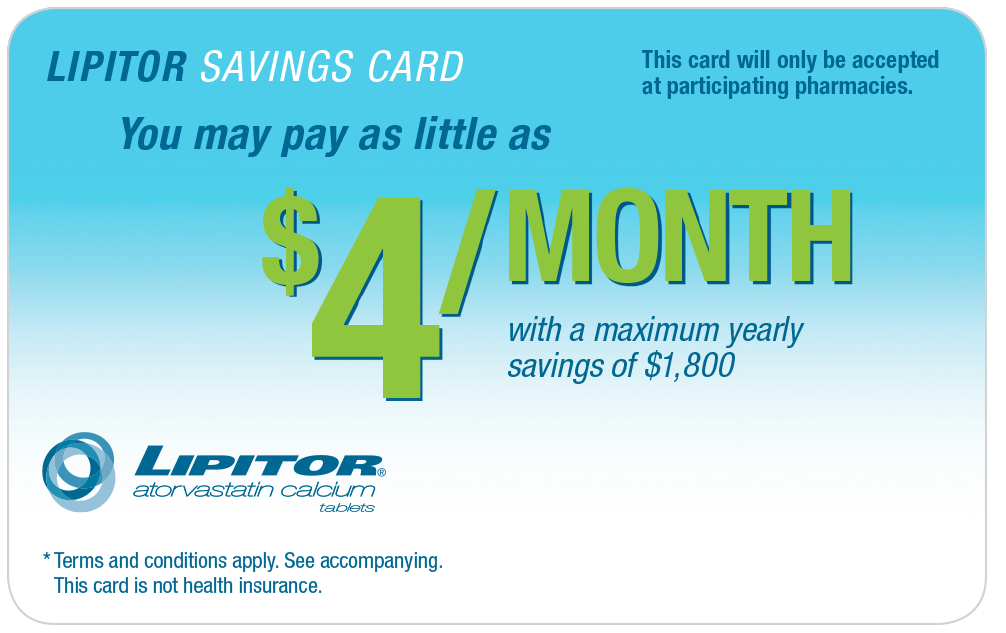
Or click here for money-saving offers.
Back to Top >>
Questions About Cholesterol
Click on a question for the answer.
- Q: What is cholesterol?
-
A: Cholesterol is a waxy substance found in the body. Having high "bad" cholesterol means you have too much LDL cholesterol in your blood. LDL cholesterol can buildup in your arteries and prevent the blood from getting to your heart. HDL cholesterol is the "good" cholesterol. It carries LDL cholesterol away from your artery walls.
Here is some basic information you should know about cholesterol:
- Too much cholesterol in the blood, or high cholesterol, can be serious. People with high cholesterol are at risk of getting heart disease. This can lead to a heart attack or stroke.
- Only about 25% of cholesterol comes from the foods you eat. The other 75% is made by the body. Factors such as age and family history affect how much cholesterol your body makes.
- People with high cholesterol usually have no symptoms. But it can be detected with a blood test. These tests can also help your doctor predict what your risk for heart disease may be.
To find out more about cholesterol, click here.
- Q: What should my cholesterol numbers be?
-
A: Your doctor knows best when it comes to your cholesterol goals, and he or she will be your partner in reaching them. National guidelines say a person’s total cholesterol number should be under 200, while 220–239 is considered borderline high, and above 240 is considered high.
National guidelines also provide direction on LDL cholesterol, part of total cholesterol and the main focus of cholesterol-lowering therapy. Having high levels of LDL cholesterol may put you at risk for heart disease. Generally, your LDL cholesterol should be below 160, if you have no other risk factors for heart disease. Managing and lowering your LDL cholesterol then helps to further reduce your risk.

If you have heart disease or diabetes, or risk factors for heart disease, your nationally recommended LDL cholesterol number may differ:

Be sure to work with your doctor to determine the LDL cholesterol goal that is right for you and your risk factors. Risk factors include age, smoking, high blood pressure, low HDL (“good”) cholesterol, or family history of early heart disease.
- Q: Why is high cholesterol a health risk?
-
A: When you have high cholesterol, a thick, waxy plaque can build up in your artery walls. As plaque builds up, the artery narrows and becomes less flexible. If a blood clot forms and clogs an artery narrowed by plaque, you could have a heart attack or stroke.
To find out more about the risk factors for heart disease, click here.
- Q: How common is high cholesterol?
-
A: More than 1 in 5 adults in the United States has high cholesterol. In adults, total cholesterol levels of 240 mg/dL or above are considered high. Levels from 200 mg/dL to 239 mg/dL are borderline high.
To find out more about cholesterol, click here.
- Q: How is cholesterol measured?
-
A: Cholesterol is measured as milligrams of cholesterol per deciliter of blood (mg/dL). Total cholesterol levels include:
- LDL ("bad") cholesterol
- HDL ("good") cholesterol
- Triglycerides (another type of fat in the blood)
To find out more about cholesterol, click here.
- Q: At what age should I start having my cholesterol checked?
-
A: Experts recommend that all adults over the age of 20 have their cholesterol levels measured at least once every 5 years.
The American Heart Association recommends that you have your cholesterol checked more often if:
- Your total cholesterol is 200 mg/dL or more
- You are a man over 45 or a woman over 50
- Your HDL ("good") cholesterol is less than 40 mg/dL
- You have other risk factors for heart disease and stroke
It's important to see your doctor regularly. For a helpful doctor discussion guide, click here.
- Q: Does menopause affect cholesterol levels?
-
A: Before menopause, women usually have total levels lower than those of men the same age. As women and men get older, their cholesterol levels continue to rise until about 60 to 65 years of age.
In women, menopause often causes an increase in their LDL ("bad") cholesterol and a decrease in their HDL ("good") cholesterol levels. And after the age of 50, women often have higher total levels than men of the same age.
- Q: How does smoking affect my risk of heart disease?
-
A: Smoking increases the risk of heart disease. Smoking raises LDL ("bad") cholesterol and speeds up the build up of plaque in the inner layer of an artery wall.
To find out more about risk factors for heart disease, click here.
For some tips on healthy living, click here.
- Q: Is diabetes a risk factor for heart disease?
-
A: Diabetes is a risk factor for high cholesterol. People with diabetes also often have high triglycerides and low HDL (“good”) cholesterol levels. These are risk factors for having heart disease.
To find out more about risk factors for heart disease, click here.
- Q: Can stress affect my cholesterol levels?
-
A: "Stress" refers to the condition resulting from a person's response to physical, chemical, emotional, or environmental factors. It can mean physical effort as well as mental tension. All people feel stress differently and react to it in different ways.
Stress may play a role in raising cholesterol by affecting an individual's habits. Some people deal with stress by overeating, by eating foods that are high in fat, or by smoking. Foods high in saturated fat and cholesterol can contribute to high cholesterol. Smoking can also contribute to heart disease.
For some helpful tips on healthy living, click here.
- Q: How often should I have my cholesterol checked?
-
A: Based on the results of a blood test and your overall risk, your doctor should develop a schedule based on your medical history.
To print a helpful doctor discussion guide, click here.
- Q: Where can I find more information about cholesterol?
-
A: The National Cholesterol Education Program (NCEP) has booklets for adults and children. To order publications on cholesterol, weight, and physical activity or request a catalog, visit their Web site or write to:
National Cholesterol Education Program
NHLBI Information Center
P.O. Box 30105
Bethesda, MD 20824-0105For more helpful websites, visit our online resources page.
Back to Top >>
Questions About Healthy Eating and Heart Health
Click on a question for the answer.
- Q: How can I make time to prepare and eat heart-healthy foods?
-
A: Eating healthy is not as hard as it may seem.
- Prepare extra food each time you make a healthy meal and freeze single-serving portions.
- When you do not have the time to prepare a meal, have one of the prepared meals.
- Bring a healthy snack or two with you to work.
- Plan to eat them when you have the most temptation.
For more healthy eating tips, click here.
- Q: I have high cholesterol, but I feel fine. Do I really need to follow a low-cholesterol diet?
-
A: Changes in your eating habits should be your first step, along with exercise, in managing cholesterol. Talk to your doctor about a healthy eating plan as well as an exercise program that is right for you.
For a helpful doctor discussion guide, click here.
And for more information and tips on healthy living, click here.
- Q: What are some healthy eating tips I can follow when dining out?
-
A: When eating away from home, plan ahead. Call the restaurant and ask about their healthy dishes (meals low in saturated fat and cholesterol).
When at the restaurant, look for words that usually mean a dish is lower in fat:
- Steamed
- Poached
- Roasted
- Baked
- Broiled
You can also ask that your food not be cooked in butter or saturated fat. And ask your waiter to bring any sauces or salad dressings in a side dish so you can control how much you use.
For more healthy eating tips, click here.
- Q: What can I do to cut back on cholesterol and fatty foods?
-
A: By creating a diary, you will see patterns you may not have known existed, such as eating when you're feeling stressed or when you're bored. For about a week, write down everything you eat and drink. And write down the time you ate, where you ate, and what you were doing and thinking when you ate.
For more healthy eating tips, click here.
- Q: What types of exercise can I do if I don't have access to exercise equipment?
-
A: Be sure to check with your doctor before starting any exercise program.
You may find ways to get exercise in your everyday activities:
- Look for opportunities to walk more often
- Take the stairs instead of the elevator
- Park your car farther away from the store in a parking lot
- If you commute, get off a stop earlier than usual
- Take your dog to the park for some fun exercise on the weekend or after work
- Play a game of tag with your children or grandchildren
- Look for exercise in chores and gardening
To find out more about staying active, click here.
- Q: How can I fit exercise into my daily schedule?
-
A: Be sure to check with your doctor before starting any exercise program.
Fit exercise into your daily routine by exercising before or after work. You can walk to and from work. You can take a walk for a break. You can walk to a colleague's desk or the water cooler. Every little bit counts!
To find out more about staying active, click here.
- Q: How can I follow an exercise program that can help me manage my cholesterol?
-
A: Be sure to check with your doctor before starting any exercise program.
Regular exercise is an important part of a cholesterol-lowering plan. For many people, moderate exercise for 20 to 30 minutes most days of the week can help. Choose exercises that you enjoy. These will give you variety to keep you interested and motivated. If you can, exercise with a friend to keep each other motivated.
Exercise during the cooler times of the day. Try to avoid exercising in hot weather. Drink enough fluids.
Do not overexert yourself. If you feel pain, are breathless, or are sick to your stomach, you are pushing yourself too hard. Be aware of serious warnings such as dizziness or light-headedness, chest pain, or heart palpitations. If any of these occur, discontinue exercise and contact your doctor as soon as possible.
To find out more about staying active, click here.
Back to Top >>